Which Laws Regulate the Taxation of Foreigners in Turkey?
In short: what taxes await a foreigner in Turkey
✅ Allowed
- If you have not settled in Turkey, pay tax only on income received in Turkey (Law No. 193, Article 6).
- Use the exceptions for those who came for treatment, study, travel or temporary business, even if you live there longer than six months (Law No. 193, Article 5).
- If you own housing, pay building tax: the rate by law is 0.1% for housing, increased by 100% within the borders of metropolitan municipalities (Law No. 1319, Article 8).
- Find the current rates and the way to pay at the tax office and on the GİB website.
⛔ Not allowed
- Assume you do not pay property tax: it is paid by the owner of the building (Law No. 1319, Articles 1 and 3).
- Assume that rental income from a flat in Turkey is not taxed: for limited-liability corporations it is part of taxable income (Law No. 5520, Article 3), and for individuals the rules of Law No. 193 apply.
- Expect one land registry fee for all cases: the rates in the table of the law were changed by decisions, so check them at the registry (Law No. 492).
- Sign a deal without a tax number: the numbers of the parties are entered in the official deed (Law No. 2644, Article 26).
- Confuse tax residence with a residence permit: they are different statuses.
This is a short summary of the text of the law. Details, quotations of articles and links to the official texts are below. The visa-free stay depends on your citizenship, and amounts and lists of countries are set by secondary acts, so check them on the date of your decision.
The taxes of foreigners in Turkey are not collected in one law: the taxation of foreigners in Turkey is determined by the income tax law for individuals, the corporate tax law for companies, the property tax law, the law on fees and the tax procedure law. Below are the main acts, an explanation of who is considered a tax resident and what the owner of a flat pays, and where to check the rates.
The material is for information and does not replace advice from a tax consultant. Rates and amounts change, so we quote rules and not specific figures, except those written directly in the law.
Where the laws are published
All the acts are available on the portal mevzuat.gov.tr, and explanations and forms on the website of the Revenue Administration of Turkey (GİB). The main acts: Law No. 193 on Income Tax, Law No. 5520 on Corporate Tax (adopted on 13 June 2006, published on 21 June 2006 under No. 26205), Law No. 1319 on Property Tax (adopted on 29 July 1970, published on 11 August 1970 under No. 13576), Law No. 492 on Fees (adopted on 2 July 1964) and Law No. 213 on Tax Procedure. Links: No. 5520, No. 1319, No. 492.

Who pays taxes: full and limited liability
The Turkish tax system divides individuals into those who have “settled” in the country and the rest. Under Articles 3 and 4 of Law No. 193, those who have settled in Turkey (their domicile under the Civil Code is in Turkey, or they live in the country continuously for more than six months in a calendar year) pay tax on all income received in Turkey and outside it. The rest, under Article 6, pay only on income received in Turkey. Article 5 names exceptions: people who came for a specific temporary job, for example on a business trip, as specialists or journalists, and also those who came for treatment, study or travel, are not considered settled even if they stay longer than six months. The original text of Law No. 193 on the official portal is published as a scan, so we quote these articles from consolidated copies and recommend checking them on the portal.
Tax residence and migration status are different things: one can live in Turkey on a residence permit and not be a tax resident, and vice versa. We will cover this in more detail in questions 318–320 of the list.
Companies: Law No. 5520
Article 3 of Law No. 5520 divides corporations in the same way. Those whose legal centre or management centre is in Turkey pay tax on all profit. The rest pay only on income received in Turkey. Income under limited liability includes trading profit from the place of business or a permanent representative, income from renting movable and immovable property in Turkey, income from securities received in Turkey, and other income.
“Taşınır ve taşınmazlar ile hakların Türkiye’de kiralanmasından elde edilen iratlar” (Article 3, paragraph 3, sub-point ç). Income from renting out property and rights in Turkey is part of the taxable income of corporations with limited liability.
Law No. 5520 lists the forms that are considered capital companies: joint-stock companies, limited liability companies and limited partnerships with shares, as well as similar foreign organisations.
Property tax: Law No. 1319
Under Article 1 of Law No. 1319, buildings located within Turkey are subject to building tax. The tax is paid by the owner of the building, or, where there is a usufruct, by the holder of that right (Article 3). The rate in the law: for residential premises one per thousand (0.1%), for other buildings two per thousand. These rates are applied with an increase of one hundred percent within the borders of metropolitan municipalities and adjoining territories where Law No. 5216 applies. The President may reduce the rates by half or raise them up to three times.
“Bina vergisinin oranı meskenlerde binde bir, diğer binalarda ise binde ikidir” (Article 8). The rate of tax on housing is one per thousand, on other buildings two per thousand.
The tax is calculated on a value determined under the rules of the law and the municipality, so it is best to find out the real amount from the municipality where the flat is located.
Fees on purchase: Law No. 492
The law on fees includes a separate section “Fees for title deeds and the cadastre” and a table of rates for various deals. The amounts of fees in the text of the law were changed by decisions of the Council of Ministers and the President, so several values appear in the text, for example “binde 20” and “binde 15” for deals in housing and premises for certain periods. That is why we do not give a single figure here: the current rate and the way to pay have to be checked at the land registry on the day of the deal. We will give a detailed analysis of charges in questions 81–85 of the list.
Tax number and the duty to submit data
A tax identification number is needed by a foreigner for the deal: Article 26 of Law No. 2644 requires the tax numbers of the parties to be entered in the official deed. It can be obtained at the tax office, and information is given by GİB. The number is used both for declaring income and for paying property tax.
How it works in practice
A foreign owner of a flat in Turkey faces at least three taxes: the fee on purchase, property tax (every year) and tax on rental income if the flat is rented out. If you live in Turkey for more than six months a year, your position as a tax resident has to be checked separately. So as not to lose money, keep contracts, payment documents and tax notices. General questions about the laws on purchase are in the article “Which laws regulate the purchase of property by foreigners”, and flats are in the catalogue. How costs and taxes relate to a purchase is also described in the step-by-step guide to buying.
Conclusion
The taxation of foreigners in Turkey is built on the difference between those who have settled in the country and the rest, and property owners additionally pay property tax and fees on deals. The exact rates and amounts are set by tax acts and Presidential decisions, which have to be checked on the date of payment. Read the other questions of this section on the page “Laws of Turkey”.
The material does not replace advice from a tax consultant. The information was checked against the texts of Laws No. 5520, No. 1319 and No. 492 as of 21 October 2026; the articles of Law No. 193 from consolidated copies.
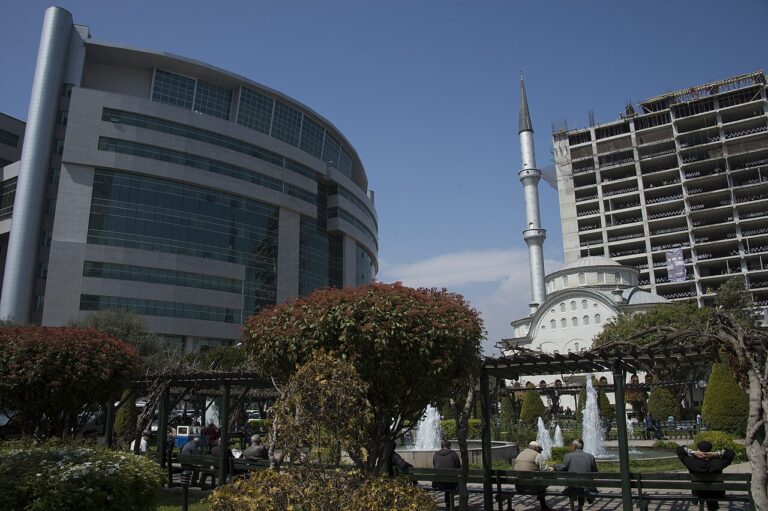
Photo: Haluk Cömertel (CC BY 3.0), Wikimedia Commons; photos of the complexes are used with the site owner’s consent.